Arun Gupta
CEO of EduKyu


According to UGC data from 2023, over 4.14 crore students are enrolled in higher education across India . Most universities shifted to the credit-based grading system, where SGPA became the standard performance measure. A 2022 AICTE survey found that 80.9% of engineering students rely on SGPA for placement eligibility screening .
Are you confused about how grade points and credits work together?
Do different universities use different SGPA scales?
Can you convert SGPA to percentage for job applications?
We'll walk you through the complete SGPA calculation process. You'll learn the standard formula, see real examples, and find university-specific tools that make calculations easier.
SGPA uses a weighted average formula based on grade points and credit hours
Each subject's grade point multiplied by its credits gives you a weighted score
Divide total weighted scores by total credits to get your SGPA
Most Indian universities use a 10-point grading scale for SGPA calculation
Convert SGPA to percentage using the formula (SGPA × 10) – 7.5
University-specific calculators help avoid manual calculation errors
SGPA affects scholarships, placements, and postgraduate admission eligibility
SGPA stands for Semester Grade Point Average. It shows your average performance in one semester based on grades and credits.
Think of it like a weighted score. If you score well in a 4-credit subject, it affects your SGPA more than a 2-credit subject. This makes SGPA more accurate than simple percentage averages.
Most Indian universities follow a 10-point grading scale. Each letter grade (O, A+, A, B) converts to a number between 0 and 10. Your SGPA uses these numbers along with credit hours to give you one final score for the semester.
Universities use SGPA to decide scholarships and academic standing. Companies often ask for SGPA during campus placements. Some postgraduate programs require minimum SGPA for admission eligibility.
You need to track SGPA from your first semester. It directly affects your final CGPA, which stays on your degree certificate. A good SGPA gives you more options for internships and placements.
Need help choosing the right online degree program? Talk to a Career Advisor (Call / WhatsApp) for personalized guidance.
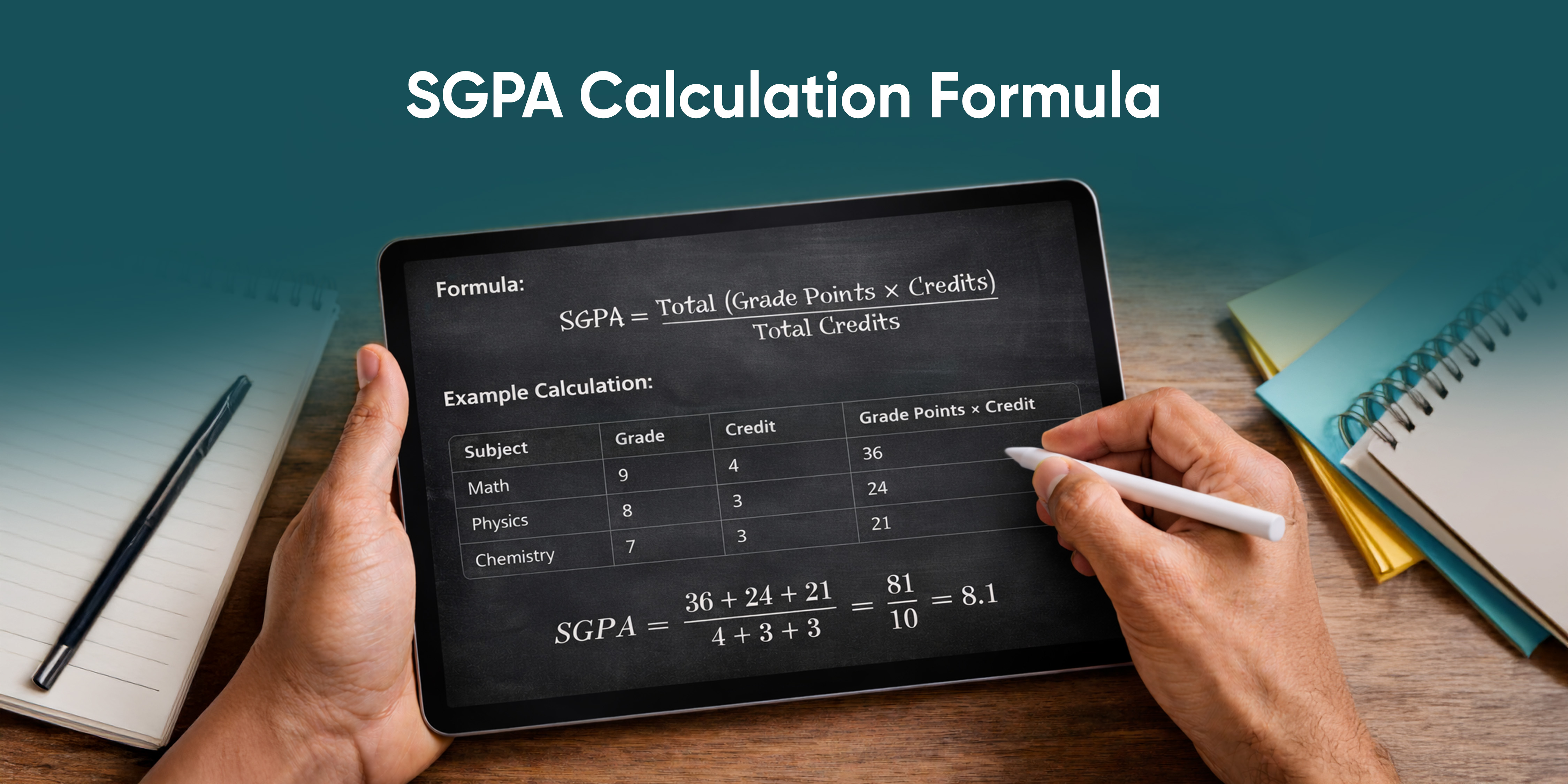
SGPA = Sum of (Grade Points × Course Credits) ÷ Total Credits
This formula uses a weighted average method. Each subject's grade point gets multiplied by its credit hours. Then you add all these weighted scores and divide by total credits attempted.
Grade Points: Your letter grade converted to a number (usually 0-10). Check your university's grading scale to match letters with numbers.
Course Credits: Hours assigned to each subject based on class time and workload. Core subjects usually have 3-4 credits, while labs or electives may have 1-2 credits.
Weighted Score: Grade point multiplied by credits for one subject. A high grade in a high-credit subject gives you a bigger weighted score.
Calculating SGPA takes four clear steps. Follow them in order to avoid mistakes.
Get your semester grade sheet. List all subjects with their letter grades. Use your university's grading scale to convert each letter to a number.
Most universities use this scale:
O or A+ = 10 points
A = 9 points
B+ = 8 points
B = 7 points
C = 6 points
Some universities use different scales. Always check your institution's official grading policy.
Find the credit hours for each subject from your course structure. Multiply each subject's grade point by its credit hours.
For example, if you scored 9 points in a 4-credit Math course, your weighted score is 9 × 4 = 36 points.
Do this for every subject in your semester.
Sum up all the weighted scores from Step 2. This gives you the total weighted points for the semester.
Make sure you include every subject you attempted. Don't skip any course, even if it's a minor or audit course.
Add up all credit hours from the semester. Divide your total weighted points by this sum.
The result is your SGPA for that semester. Most universities round it to two decimal places.
Let's calculate SGPA for a student who took three subjects in one semester.
Subject Grade (Point) Credits Weighted Score Mathematics 949 × 4 = 36 Physics 838 × 3 = 24 English 10210 × 2 = 20 Total 980SGPA = 80 ÷ 9 = 8.89
This student's SGPA for the semester is 8.89 out of 10.
The student earned 36 weighted points in Math because it was a 4-credit course. Even though English had the highest grade (10), it contributed only 20 points due to fewer credits.
This shows why credit weighting matters. Your performance in high-credit subjects affects SGPA more than low-credit subjects. Focus on core courses to maintain good SGPA.
Many Indian universities provide online calculators for SGPA. These tools follow their specific grading scales and credit systems.
VTU students can use the official VTU SGPA Calculator. It supports the 2018, 2021, and 2022 scheme structures. Enter your grades and credits to get instant results.
VTU follows a 10-point scale with specific credit structures for engineering programs. The calculator accounts for all these details automatically.
MAKAUT students should try the UCanTool platform. It handles SGPA calculation and helps with scholarship form conversions. The tool works for both old and new MAKAUT schemes.
MAKAUT uses different credit distributions for theory and practical subjects. The official tools handle these variations correctly.
Sastra University provides an SGPA guide on their student portal. They use a 10-point grading scale with specific weightage for different course categories.
Refer to the official Sastra guide if you're calculating SGPA for internal assessments or final semester grades.
JNTUH students in Hyderabad can access the JNTUH Calculator. It's designed for their credit structure and grading pattern. The tool includes options for all JNTUH-affiliated colleges.
JNTUH has unique credit distributions for lab courses and projects. Use their calculator to avoid manual calculation errors.
Most Indian universities convert SGPA to percentage using a standard formula:
Percentage = (SGPA × 10) – 7.5
This formula applies to 10-point grading scales. If your SGPA is 8.5, your percentage would be (8.5 × 10) – 7.5 = 77.5%.
Job applications often ask for percentage instead of SGPA. Government exams require percentage for eligibility. Some postgraduate programs accept only percentage-based scores.
Convert your SGPA to percentage when filling out application forms. Keep both scores ready for placement drives and interviews.
Some universities use different conversion formulas. VTU, Anna University, and Mumbai University each have their own methods. Check your university's official formula before converting.
If your university doesn't provide a formula, use the standard (SGPA × 10) – 7.5 method. This works for most institutions across India.
Confused about university grading systems for online programs? Connect with our counselors (Call / WhatsApp) to understand better.
SGPA measures one semester's performance. CGPA (Cumulative Grade Point Average) measures your overall performance across all semesters.
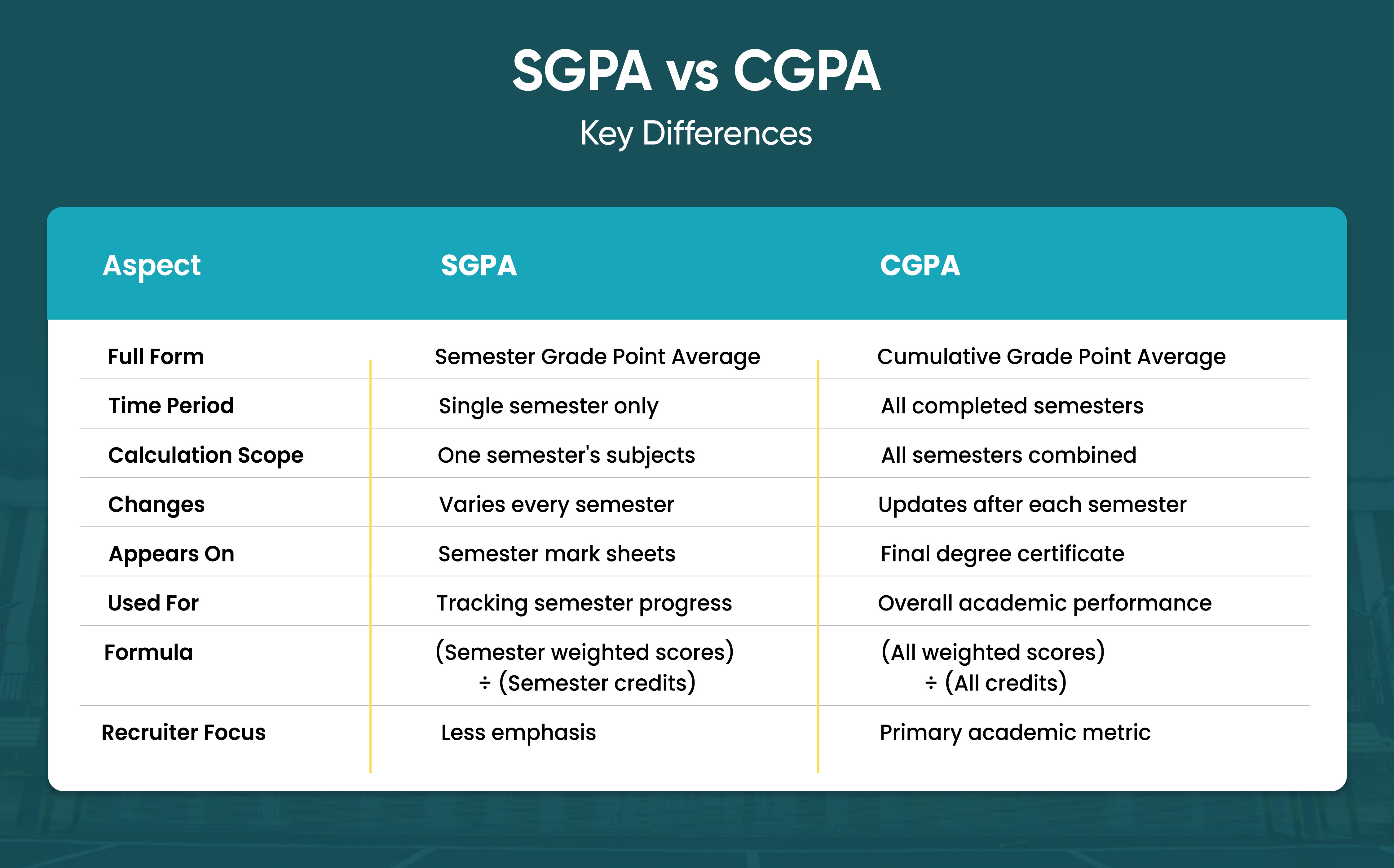
CGPA calculation follows the same weighted average method as SGPA. But instead of one semester, you include all semesters you've completed.
Add up weighted scores from every semester. Divide by total credits from all semesters. The result is your CGPA.
Universities report SGPA on semester mark sheets and CGPA on final degree certificates. Recruiters look at CGPA to understand your full academic record. A strong SGPA in your final semesters can improve your overall CGPA.
Track both scores throughout your degree. If your early SGPA was low, focus on improving later semesters to lift your CGPA.
Students often make errors when calculating SGPA manually. Avoid these common mistakes.
Some students just average their grade points without multiplying by credits. This gives wrong results. Always multiply each grade point by its corresponding credits first.
A 10-point score in a 1-credit course affects SGPA less than an 8-point score in a 4-credit course. Credit weighting is not optional.
Different universities use different point scales. Some use 4-point scales, others use 10-point scales. Make sure you're using the right scale for your institution.
Check your official grade card for the grading scale. Don't assume all universities follow the same system.
Some courses don't carry credits or don't count toward SGPA calculation. Audit courses and pass/fail courses often fall into this category. Don't include them in your calculation.
Look for a "credit hours" column on your grade sheet. If a course shows zero credits, exclude it from SGPA calculation.
You can improve SGPA by focusing on high-credit subjects and consistent performance.
Core subjects usually have more credits than electives. Scoring well in these subjects has a bigger impact on SGPA. Spend more time preparing for high-credit courses.
If you're weak in a major subject, get help early. Don't wait until the end of the semester to fix problems.
Calculate your expected SGPA after each exam cycle. This helps you know where you stand. If your SGPA is dropping, you can adjust your study strategy before final exams.
Most universities provide mid-term grades or internal marks. Use these to estimate your semester performance and make changes if needed.
Taking too many high-credit courses in one semester can hurt SGPA if you can't manage the workload. Balance your schedule with a mix of difficult and easier subjects.
Talk to seniors or academic advisors about course difficulty. Plan your semester load based on your capacity and other commitments.
Planning to pursue an online degree while working? Get expert advice on managing studies and career. Talk to a Career Advisor (Call / WhatsApp).
EduKyu connects students and working professionals with UGC-approved universities like NMIMS, Amity, Manipal, and Jain University since 2015. We focus on making online education clear for tier-2 and tier-3 city learners.
Our career advisors break down NAAC grades, fee structures, and EMI options in simple language. You get honest answers to real questions: Will this degree work for government jobs? Can I study while working? Is this university recognized?
We provide one-on-one guidance through WhatsApp and phone calls in your preferred language. No pushy sales, just transparent information to help you choose the right program.
Talk to a Career Advisor (Call / WhatsApp) to explore online degree programs that match your goals.
Calculating SGPA is straightforward once you understand the formula and steps. Match your grades to points, multiply by credits, sum the weighted scores, and divide by total credits. Use university-specific tools when available to save time and avoid errors.
Your SGPA directly affects placements, scholarships, and higher education eligibility. Track it every semester and focus on high-credit subjects to maintain strong academic standing. Convert SGPA to percentage when applying for jobs or government programs.
Keep your grade sheets organized and calculate SGPA right after each semester. This helps you plan better for your career and educational goals.
What is the formula to calculate SGPA?
SGPA equals the sum of grade points multiplied by credits, divided by total credits. This weighted average gives you your semester performance score.
Can I convert SGPA to percentage?
Yes, use the formula (SGPA × 10) – 7.5 for most universities. Check your institution's specific conversion method if available.
Does SGPA include all subjects?
SGPA includes only credit-bearing courses. Pass/fail courses and audit subjects don't count toward your SGPA calculation.
How is SGPA different from CGPA?
SGPA measures one semester while CGPA measures your cumulative performance across all semesters. Both use the same weighted average method.

CEO of EduKyu
A seasoned expert with 11 years of experience in creating impactful content on distance education and online MBAs. Over the years, I have elevated EduKyu into a top platform, bridging students with universities for comprehensive and accessible higher education.

No blogs found for this category.